|
|
|
|
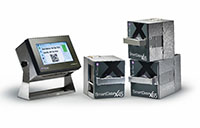
Item # SmartDate X65/128, SmartDate® Series 128 Millimeter (mm) Width Coder
|
|
|
|
|
|
For over three decades, Markem-Imaje has pioneered thermal transfer coding technology. Our comprehensive SmartDate® Series of coders provides the most reliable high-quality codes on flow-wrappers, bags, tray seals, pouches, sachets, vacuum packs or labels.
|
|
|
|
|
|
|
|
|
Durable wear resistant design. Adaptable for intermittent or continuous line configuration. Left- or right-hand operation. Meets extreme production line speeds. Multiple ribbon save features. Industry leading 0.5 mm gap between prints. Capable of serialized 2D codes.
|
|
|
|
Multiple user interface options including color touch screen and web pages. Dedicated buttons for frequently used functions. USB for image and file data transfer. Equipped with power save mode.
|
|
|
|
If you require complex message design with logos or networking and data management linked with your ERP, our scalable Packaging Intelligence Suite can help reduce your overall running costs and operator error, achieve compliance and maximize productivity.
|
|
|
|
The Markem-Imaje SmartDate® Series offers the versatility you expect at a lower cost of ownership for coding on flexible packaging films, foils and labels. Reliability combined with unique ribbon saving options ensure significant savings in consumables and maintenance costs. Use the Systech Packaging Intelligence Suite™ to network and manage your coders with message management, verification and line control solutions.
Food
Designed to print crisp, clean codes on a variety of substrates used in retail food and food service, even on packaging lines that run around the clock.
Pharmaceutical
High quality, permanent codes on pharmaceutical packaging materials such as labels, blister packs and films.
Household
Whether you are producing trial sizes or family packages, SmartDate® thermal transfer coders are ideal for printing directly on labels or flexible film.
|
|
|
|
Flexible film and foil packaging coding
Printing capabilities of Markem-Imaje
Thermal Transfer Overprinter (TTO) coders
Understanding Thermal Transfer Overprinting (TTO)
While other coding methods have multiple uses, TTO is a digital printing technology that has been developed specifically to be used with flexible materials, making it ideally suited for this process.
Thermal Transfer Overprinting is a contact coding process which transfers ink from a ribbon to the material, using a thermal printhead.
Thermal transfer technology combines a thermal printhead and a polyester ribbon coated with ink on one side. Ink is transferred from a ribbon to the packaging material using a thermal printhead. This is made up of a row of independent tiny heating elements, mounted on a ceramic support. The different heating elements are activated based on the characters to be printed, melting the ink on the ribbon and transferring the selected characters to the packaging film. The printhead and the ribbon move with the material during this process.
There are two types of thermal transfer coders depending on the application
Intermittent mode
In an intermittent mode the packaging film advances and then stops, such as on a Vertical Form Fill and Seal (VFFS) machine, labeller or tray sealer. The printhead lowers, moves along the packaging film and ribbon. The printhead prints. The printhead is raised, and returns to the home position, the ribbon advances and the process is repeated.
Continuous mode
In a continuous mode the packaging film is constantly moving such as on a Horizontal Form Fill and Seal (HFFS) machine. When triggered, the ribbon accelerates to the film speed, the printhead is lowered and printing begins. At the end of printing the printhead is raised to the home position and the ribbon stops moving.
With a typical output of 300 dpi, TTO offers very high print quality that blends in with the overall design of the pre-printed film. In addition to printing variable information such as best-before dates, barcodes and promotional information, it can also help reduce pre-printed stock by printing static information, such as the product name.
|
|
|
|
|
|
|
|
|
|
|
|
|
|
|
|